
Episode #99: Zohar Bronfman – Co-founder and CEO of Pecan AI
Dr. Zohar Bronfman – The Limits of Knowing Dr. Zohar Bronfman is the... Read more


Episode #99: Zohar Bronfman – Co-founder and CEO of Pecan AI
00.00/57:41
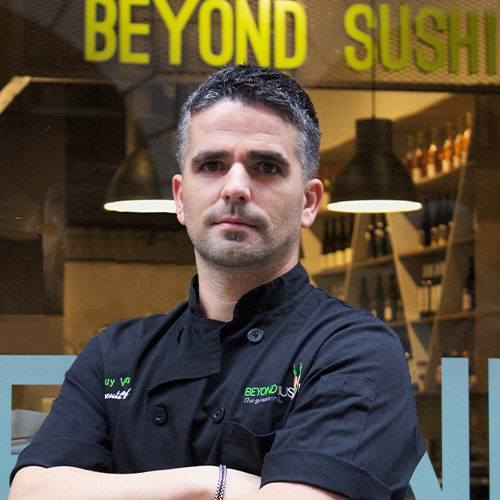
In this episode of the RealLifeSuperPowers podcast, we speak with Chef Guy Vaknin, a vegan entrepreneur, owner of Beyond Sushi – a NY Sushi Chain that currently serves over 2 million people.
Guy had a lot of experience working various jobs in the restaurant business. But before going all in he enrolled in college to study computer engineering. Then, like many entrepreneurs we speak with, the college system didn’t feel right and he dropped out after 3 months. In his unique case, his father, who was already in the business, encouraged him to drop out and join him in business.
6 years later, after working alongside his dad, who enabled and empowered him to fail and experience the real world, he felt ready to open up his own business and Beyond Sushi came to life. He realised there’s business potential in the vegetarian food business and despite most people around him telling him he’s insane, he took all his money, loaned more from his father and invested it all, fully believing in his idea. When he opened the first restaurant he had 1000 USD left in his bank account, it HAD to work or else he’d have to close and go back to working for his father.
Guy says that when you’re unique you draw attention. It’s then a matter of executing at a high level. He’s referring to the restaurant industry but we think this can be applied in all industries.
He’s a master at pitching. Not long ago he was on Shark Tank and got the sharks to invest 1.5 million dollars for 15% in Beyond Sushi and 30% in another business he’s working on. He shares insider tips on how to pitch. Among other things he says it’s important to show business potential and back it up with numbers “the numbers don’t lie”.
He knows how to combine creativeness with pragmatism, listening to him can be very inspiring for creatives trying to figure out how to ground their passion.
We hope you enjoy your listen.
Zooming out, if you like listening to this podcast, make sure to subscribe so you don’t miss new conversations with peak performers, serving as a reminder we can all tap into the best versions of ourselves.
You’re also welcome to follow Ronen and Noa on Linkedin
And if we may ask for a favor – please leave us a review on your native podcast app.
Some further resources:

[This transcript was generated from YouTube’s auto-captions, not a verified human/AI-diarized transcript. Timestamps and wording may contain errors, and speaker labels below are Claude’s best-effort inference from context, not confirmed against audio. Please review before publishing.]
[Music]
Host: We’re here with Chef Guy Vaknin, a vegan entrepreneur, owner of Beyond Sushi, a New York City sushi chain. Guy, what’s up, how are you?
Guy: Hey guys, how are you? Thank you for having me.
Host: Thank you for coming on our podcast. What are you up to these days, besides having two kids at home?
Guy: Being the bookkeeper, the mother, the father, the dishwasher, the motivator — not much, honestly. It’s hard. I have almost a hundred employees and a lot of systems in place. Restaurants are difficult because there are so many factors that can go wrong in a day — customers, deliveries, logistics, running between locations, delegating, and even when you delegate, you still have to go and hold people accountable, over and over.
Host: How many branches does Beyond Sushi have these days?
Guy: Six — three smaller ones and three bigger ones. We’re also running a commissary, a main kitchen, corporate offices, marketing, catering — a whole ecosystem.
Host: How did you end up opening this chain? It’s not a typical restaurant concept.
Guy: It’s a pretty odd and unique idea. I came to the US in 2005 and worked for my father, who had a bunch of restaurants that he eventually condensed into a catering company. Like a lot of father-and-son businesses, that eventually didn’t work out between us, and I decided to venture out on my own. I’d worked every job under the sun in hospitality — server, manager, door at a club, bartender, everything — and I loved the industry, but I went the route everyone expects and enrolled in college to study computer engineering, here in the city. After three months I realized it wasn’t for me — I couldn’t sit still — so I left. I’d always dreamed of studying cooking, so my dad offered to pay for culinary school instead. After seven months, as soon as I finished, he told me I was now the executive chef running one of his places. I was 23. I lost him a bunch of money at first because nobody really knew what I was doing, and then eventually made him a lot of money. Six years into that, I decided to go out on my own with this odd, unique idea.
Host: How did it actually start?
Guy: It started at my dad’s catering company — we had to put together a sushi station and got a lot of requests for a vegetarian option, so I made one. We tested it at the New York Vegetarian Food Festival two years in a row and sold out completely both times, so I knew there was something there. When I actually tried to build a business around it, everyone told me I was crazy and it would never work. I did it anyway, mostly on my own — took an investment from my dad, put in everything I had, and altogether had about a hundred and forty thousand dollars. I opened my first location — twelve seats, a counter, me and one other employee — and made it work. I had a thousand dollars left in my bank account when I opened. If it hadn’t worked in the first month, I would have been done.
Host: It sounds like your father was a big influence.
Guy: My father basically gave me the platform, but I had to work hard for it. At that point I think he actually wanted to prove a point — he gave me the money to open the first restaurant, but deep down I think he expected me to fail and come back for help. Instead I paid him back in under a year. I think that pressure is exactly what drove me to make it work, no matter what — which ended up being a win for both of us.
Host: How do you pitch a genuinely unique restaurant concept and get investors excited, in an industry that’s already so saturated with ideas?
Guy: It’s endless, honestly — you can always innovate and renovate. I decided early on that no matter what, I was going to be as unique as possible. Being unique draws attention, but you also have to execute at a high level — if you execute well, you’ll be successful regardless. For me, being unique meant people had to come to me specifically, because they couldn’t get what I made anywhere else. Of course that can also fall flat if it’s just a gimmick and you don’t execute — but I opened a second location after ten months, and a third about a year after that, without any outside investment. After that, for investors, you have to show proof — not just that the idea works in theory, but that it works in the numbers. The biggest thing investors want to see is that a restaurant concept can be duplicated — most restaurants can do one great location and then struggle to repeat it. From the beginning, my model was smaller storefronts fed by one central commissary that handles all the production and ships out every night, so each location doesn’t have to prep everything from scratch. It’s a lot of logistics, but it lets you scale while keeping quality and consistency high.
Host: So you produce everything centrally and distribute it out to the restaurants?
Guy: Exactly — I prepare everything for them, so nobody’s cutting vegetables to order at the counter. Producing at a bigger scale in one place means lower overhead — the same team can produce for every location instead of duplicating that work six times over.
Host: How do you know how much food to make each day? That’s always fascinated me about restaurants.
Guy: I came from the catering world, where everything is speculative — you guess what an event needs, and whatever you don’t use gets thrown away. What I built here is a very limited set of SKUs — about forty ingredients and seven sauces — that the entire menu is built from, reused across different dishes. I thought through the production process before I ever wrote the menu. I was also fortunate to build a loyal following — over half our customers come back a second, third, even fifth time, spending real money with us monthly — so I can predict demand by season pretty precisely. On a given day, around ninety percent of what we prep goes out, and the waste is maybe four percent. I’m very obsessive about logistics and numbers — sometimes to a fault — making sure the right quantities go to each location every day.
Host: Was there a steep learning curve for that?
Guy: Definitely — it took time, and you have to build real systems. Today I can look at our daily inventory sheet and tell immediately if something’s off. What I did early on was take ordering out of the individual restaurants’ hands — each location has a simple spreadsheet that estimates what they’ll need for the day based on averages, and a logistics team packs and sends it over centrally. Perfecting that logistics layer was one of the hardest parts of building this at scale.
Host: Did you learn that from experience, or is that just how your mind works?
Guy: A lot of trial and error. I think running any part of a business really comes down to one simple loop: you measure, and you adjust. Measure, adjust, measure, adjust — with people, product, food, anything. If you can’t measure something, you’re not really managing it. A lot of restaurants lose track of their numbers somewhere along the way, and that’s often why they fail.
Host: You went on Shark Tank and got an investment — a million and a half dollars for fifteen percent of the current business and thirty percent of a future concept, if I remember right.
Guy: That’s right. I actually went in asking for a thirty-million-dollar valuation, which I knew was a stretch going in — I expected to negotiate. I knew they’d like the product because it’s unique.
Host: What did you want to do with that investment?
Guy: The plan — and it’s still very much in progress, because it’s not as fast as it looks on TV, there’s a lot of contracts and work behind the scenes — was to use the money to open locations on the West Coast, in LA. Over the years we’d gotten a ton of interest from around the world — there’s even a copy of the concept in Israel — but LA was always the market people asked us about most. Beyond the money, there was also the publicity factor, which I told the Sharks directly, even though they didn’t air that part — you want your name out there. As big as we are within our community, plenty of people in the city still don’t know we exist.
Host: It sounds like you’ve always understood the value of storytelling — you even went on Hell’s Kitchen.
Guy: I learned a lot from that experience. First, you need a good story — fortunately I have one: small town in Israel to the biggest city in the world. But you also have to be bold enough to actually tell it, and make it sound interesting even when it might not seem like much on paper. A lot of people are afraid of how their story, or their content, will land with an audience. I never really had that fear — I wanted to show I do what I do well and that I’m confident about it. That attitude got me to Hell’s Kitchen, though even there I learned along the way. I first tried out for season eight and didn’t get in — I got in on season ten, after trying again. Part of what changed was that I paid attention to what they actually wanted from the interview process — a reality TV personality — and gave them that in season ten, even though it wasn’t necessarily exactly who I am day to day.
Host: What did you give them in season eight that got you turned down, versus season ten that got you in?
Guy: In season eight I gave them a pretty serious version of myself. In season ten I gave them a more exaggerated, bigger version — more of what reality TV is actually looking for. On the show itself I didn’t want to overdo it and make myself look foolish on national TV, so I dialed it back to something honest. But once you’re on, you’re on — you get your foot in the door and go from there. Same lesson applied with Shark Tank — I told my team going in, this is reality TV, it has to be interesting, it has to have a story, it has to be fun on every platform. That’s something I’ve learned about marketing generally — even when you’re talking about serious numbers and serious business, the marketing itself has to be fun and entertaining for the viewer.
Host: Do you consider yourself a vegan activist?
Guy: I wasn’t when I opened the restaurant, but I became one — this world and this community teach you a lot, whether you’re looking for it or not. For me it became something I had to fully commit to. I can make butter, cheese, and cream taste amazing, but going vegan challenged me to actually rethink how I cook. It became my lifestyle — I believe in it fully now. My kids are vegan, my wife is vegan.
Host: You’ve talked about the numbers, the execution, the marketing — but there’s something in between that I’m curious about: pricing. Vegetables can actually be more expensive to source than something like a basic hamburger patty. How do you manage pricing given costs, and where do you see the trend going over the next five to ten years?
Guy: My approach from the beginning was to make it accessible. A lot of vegan restaurants — I don’t want to say pretentious, but they price things as if the raw ingredients themselves are more expensive, when they’re usually not; vegetables are generally cheaper than meat. If you price for volume rather than treating it as a premium niche product, you get a lot more exposure and reach people who wouldn’t otherwise try vegan food. About sixty percent of our customers aren’t vegan — they come in for something good and healthy that they haven’t tried before. I still run one of the best food costs in the industry in America without charging inflated prices — a roll is six-fifty or six-ninety-five, eight pieces, filling, and you can have a full lunch for around twelve dollars.
Host: How do you know sixty percent of your customers aren’t vegan — do you survey them?
Guy: We’ve done that a few times over the years, and it still holds up as roughly accurate. When we first opened our Midtown location, I was actually surprised to see guys in suits coming in for business lunches — I’d assumed our core customer base would skew mostly toward women, but it’s become a real part of the lunch crowd.
Host: What’s the actual end goal — a hundred locations, something specific?
Guy: If you have a fixed end game, there’s no real journey left. I’m enjoying what I’m doing right now — we’ve served over two million people, and I’m genuinely proud of that. But the future beyond that is still a bit of a mystery to me. I’ll keep going, I have a vision of what I want to build along the way, but there’s no fixed finish line. I actually have six other restaurant concepts already worked out in my head, menus and all, and I could execute any of them quickly — the hard part is building a company structure that can actually support that kind of growth, whether that’s more locations here in New York, expansion to the West Coast, or somewhere else entirely. Building a company that can run, move, and grow somewhat independently of me personally, instead of me having to drive every single piece of it, is genuinely hard, and I’m still working on it.
Host: What’s your take on franchising versus opening more company-owned locations yourself?
Guy: I have no direct experience franchising, honestly. My sense is that to make franchising work as the franchisor, you need real scale. I’ve had people ask about buying a franchise from us, but I’ve never taken that route — the product is delicate, and even I struggle to keep it exactly as I want it. I can’t imagine handing that to someone with no experience in this specific kind of food. From the franchisee’s side, owning a franchise is really just owning a job — you can grow sales within the model you’re given, but you can’t really evolve or change the concept on your own terms. If you want to actually own a company, in my opinion, you should build your own rather than buy someone else’s. It comes down to how much risk you’re willing to take — with more risk comes more potential upside, and you can generally make more money owning your own concept than running someone else’s franchise.
Host: Let’s go back to how you became vegan — it sounds like it started as a business decision that became a genuine ideology.
Guy: It happened almost by accident, honestly. When I started the business it wasn’t vegan-focused at all — I set out to build a healthy alternative to a typical sushi or lunch spot. I didn’t know much about the vegan world at the time. About ninety percent of the menu happened to be vegan and ten percent vegetarian with some egg products. Word got around the New York vegan community that there was a new sushi-adjacent concept that was mostly plant-based, and they all wanted to try it, so I’d constantly have to clarify item by item what was vegan versus vegetarian. One customer in particular texted me nearly every day, pushing me to make the whole menu vegan. I finally tried reworking the egg-based recipes to be fully vegan, and it turned out to taste basically the same, so I thought, why not. About two weeks after opening, I made the switch — probably the best business decision I’ve made, and one of the best personal decisions too. It built a really loyal community that kept us alive in the early days and helped spread the word. Health-wise, I lost close to thirty-five pounds after making that change, and at that point there was no going back for me personally.
Host: If, hypothetically, you decided to pivot to a completely different culinary direction, could you?
Guy: Honestly, no. I haven’t touched chicken, fish, or meat in years, and I genuinely can’t imagine going back — I used to be about as committed a meat-eater as you can be, but that part of me is gone now.
Host: Do you see yourself as an activist, leveraging the business for that?
Guy: Not really in that sense. One thing that’s worked well for the business is that I don’t preach to anyone — people make their own choices. If I can win someone over by having them actually taste the food, that’s enough for me; I don’t care if someone eats vegan once a week or every day. We actually have a policy in the restaurant — a lot of people don’t realize the name means the food is vegan, and they’ll come in, realize there’s no fish, and start to walk out. If that happens, we give them a roll on the house, and if they like it, they pay for it; if not, they don’t. Nine times out of ten, people end up staying and ordering more.
Host: Most restaurants worldwide don’t survive long-term — you’d agree with that?
Guy: Completely agree.
Host: So what’s your superpower, and what do you think makes you successful?
Guy: I’m not trying to inflate this, but I think I just operate at a much higher intensity than most people do most of the time — it takes a lot of energy, dedication, and sacrifice. People don’t fully appreciate how intricate this industry is. I always say, if you’re going to open a restaurant, be ready to bleed for it — that’s how much it takes out of you. Don’t do it unless you genuinely love it, because the math otherwise doesn’t make sense. If you love it, you can actually enjoy the grind. Over the years I’ve learned to handle a lot of pressure and juggle a lot at once — this industry is notoriously brutal, everyone in it is essentially on call constantly. One thing that helps is that because I’m the chef myself, I cook with the numbers in my head the whole time, not just creatively — a lot of chefs cook purely for creativity without tracking what their ingredients actually cost, and end up pricing dishes without really understanding their own margins. I also cut out middlemen wherever I could — because we produce at scale, I can buy directly from importers instead of distributors, which alone cut five or six percent off our food costs. You have to be resourceful, pay close attention to detail, and stay genuinely open to feedback.
Host: It sounds almost like the MVP, test-and-iterate approach we see in tech — you build something, get real feedback, and adjust based on what actually happens rather than what you assumed.
Guy: Exactly. Chefs are usually artists first, and I understand that instinct, but if you want an actual business, you can’t only be an artist — you have to think about the numbers first and figure out how much creative freedom you can afford within that. It’s the opposite of how most people approach it, but you can’t run a business without paying your staff, your bills, your rent. People constantly ask if we’re organic or fully local — if I committed to that, I’d have to charge three times what I charge now, and I wouldn’t have a business. For me it’s simple math, plus and minus — stay on top of it, work hard, and be innovative within those constraints, and you’ll generally be fine.
Host: What would you say is your kryptonite?
Guy: I have a really hard time letting go of responsibility for things. I can’t walk past something that isn’t working without saying something or jumping in myself, even when running a larger company means you sometimes need to let a manager own a problem and fix it themselves. That’s still a real struggle for me — letting people do their jobs so I can focus on mine, instead of taking over things I probably shouldn’t.
Host: Do you have processes in place to help you delegate more?
Guy: It’s not really about the processes themselves — companies can have plenty of good processes, but it comes down to whether people are actually executing and being held accountable. There’s also been a real shift over the past few years — it’s become very easy for employees here to just leave for another five or ten thousand dollars a year elsewhere, especially in a competitive market like New York. It’s genuinely hard to retain good people right now, and people will actively poach staff from you. It’s one of the hardest parts of this business.
Host: One year from now, if we sat down again — what will have changed?
Guy: I expect to have three more locations, and we’re also moving toward a full-service format — we already have one full-service location, and we’ll build more of those. Hopefully three more units, and on our way toward that West Coast expansion, if everything goes according to plan.
Host: Plans and reality don’t always line up, though.
Guy: Right, but that’s fine — life is dynamic, so let’s keep it dynamic.
Host: Maybe that’s your actual superpower — staying dynamic.
Guy: I think so too.
Host: Guy, thank you so much. I hope you keep bringing new, genuinely unique products into the food world, keep succeeding, and keep giving other entrepreneurs — especially fellow Israelis building things abroad — a reason to believe it’s possible. Good luck, and thank you.
Guy: See you soon, thank you guys.
[Music]
We have the technology. Real Life Superpowers.
[Music]
Dr. Zohar Bronfman – The Limits of Knowing Dr. Zohar Bronfman is the... Read more
Building a Company That Doesn’t Depend on You Naveh Ben Dror is the... Read more
Life Is a Game Lior Pozin built AutoDS into a company with more... Read more
What started as an idea between two Technion graduates became one of the... Read more
Going all in, whatever it takes In this episode, we speak with Lior... Read more
In this episode, we speak with Eli Goodman, co-founder and CEO of Datos,... Read more


